
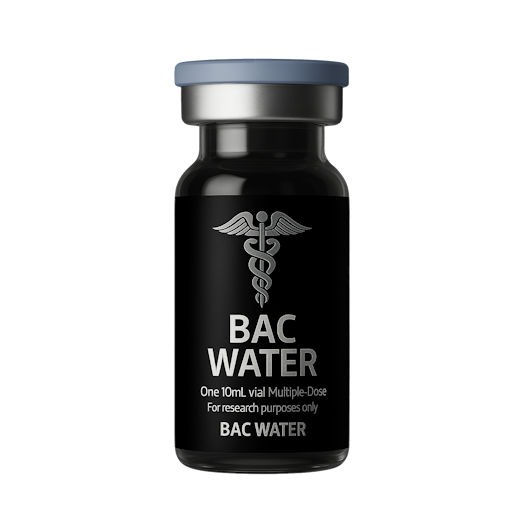
Bacteriostatic Water (BAC Water) is a sterile aqueous diluent containing a low concentration of antimicrobial preservative for laboratory preparation and handling of research materials. It is utilized in controlled settings for reconstitution, dilution, and device/systemic flushing simulations where a preservative-containing water vehicle is required for short-term multi-entry use in research workflows.
Components: Sterile water for research use with benzyl alcohol ~0.9% (v/v) as a
bacteriostatic preservative.
Physicochemical: Clear, colorless solution; osmolality near water; pH monitored per lot
to research-grade specifications.
Container/Closure: Multi-entry vial with elastomeric stopper designed for repeated puncture
during the stated in-use period under aseptic technique.
Compatibility: Intended as a general diluent vehicle in bench-top and preclinical workflows;
verify material compatibility with target analytes and device components prior to use.
Use Case: Reconstitution/dilution of research materials, instrument priming, and procedural
simulations where preservative-containing water is acceptable.
Asepsis: Employ aseptic technique at all times; disinfect septum prior to each access and
minimize environmental exposure.
In-Use Period: Multi-entry use is limited to a short, defined window once vial sterility is
first breached; discard remaining contents at the end of the in-use period per lab SOPs.
Revitalized Health solutions are prepared in controlled environments aligned to cGMP principles. Each BAC Water lot undergoes sterility testing, preservative content verification, HPLC identity/assay confirmation for benzyl alcohol, particulate examination, and endotoxin screening to research-grade limits. Batch Certificates of Analysis document methods, acceptance criteria, and results for traceability.
Store unopened vials at 20–25 °C (excursions 15–30 °C), protected from light. After first puncture, record open date/time and use within the lab-defined in-use period under aseptic conditions; keep vial tightly stoppered between withdrawals. Do not freeze. Discard if contamination, turbidity, or discoloration is observed.
For laboratory research use only. Not intended for human or veterinary injection, therapeutic, or diagnostic application. Supplied exclusively to qualified professionals conducting controlled scientific studies.
Prepared for research applications. Sterility, preservative assay, and endotoxin data provided per batch. Not medical advice.
Identity: Bacteriostatic Water for Injection (WFI + 0.9% w/v benzyl alcohol), sterile, non-pyrogenic.
Use: Sterile diluent for reconstitution of compatible parenterals; multi-dose vial use supported by preservative (typ. discard within 28 days of first puncture). Not intended for direct IV infusion without appropriate admixture; avoid intrathecal use.
Analytics: Sterility per USP <71>; bacterial endotoxins (LAL) per USP <85> (e.g., NMT 0.25 EU/mL); preservative efficacy USP <51>; particulate matter USP <788>; TOC USP <643>; conductivity USP <645>; pH (typ. ~5.2–6.2). Labeling/Handling: Single clean puncture technique; swab septum; store controlled room temp; inspect visually—do not use if cloudy/particulate or seal compromised. Warnings: Do not use in neonates due to benzyl alcohol toxicity (“gasping syndrome”).
For site education on sterile diluents in research/compounding contexts. Not medical advice.