
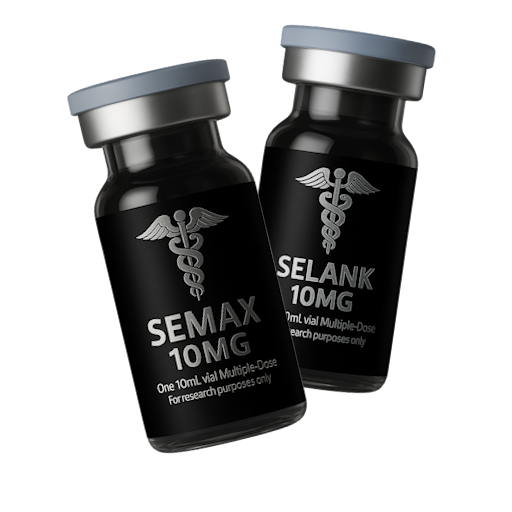
BrainStack: Selank + Semax combines two research neuropeptides—Selank (a tuftsin-derived heptapeptide with anxiolytic and neuromodulatory properties) and Semax (ACTH(4–10) derivative with neurotrophic/neuromodulatory activity). The stack is used in experimental neuroscience to probe complementary pathways underlying stress regulation, attention, learning/memory, and cortical network plasticity in translational models.
Selank (Tuftsin analog): Literature examines modulation of GABAergic tone, serotonergic balance, and
stress-axis readouts (anxiolytic profiles) with potential effects on cytokine signaling and neuroimmune crosstalk.
Semax (MEHFPGP): Associated with upregulation of neurotrophin-linked gene programs (e.g., BDNF pathways)
and downstream MAPK/ERK, PI3K/Akt cascades that support synaptic protein expression and plasticity.
Rationale for Co-Administration: Selank’s anxiolytic neuromodulation + Semax’s neurotrophic signaling create
a complementary framework for investigating attention control, learning performance, and resilience under cognitive or
inflammatory stressors in preclinical paradigms.
Stress reactivity and anxiolytic profiling • Cortical plasticity and LTP/LTD assays • Attention and executive-function metrics • Neuroinflammation and redox-homeostasis models • Synaptic proteome/transcriptome readouts • Post-insult recovery frameworks integrating behavior and electrophysiology.
Revitalized Health peptides are produced under cGMP-aligned conditions with pharmaceutical-grade inputs. Each component (Selank and Semax) is confirmed at ≥99% purity by HPLC with identity verified via LC-MS/MS. Batches undergo appearance/solubility checks and microbial/endotoxin screening to research-grade specifications. Lot-specific Certificates of Analysis document analytical methods, parameters, and results.
Store lyophilized vials at 2–8 °C, protected from light and moisture. Following reconstitution with bacteriostatic water, maintain at 2–8 °C and utilize within 20 days. Avoid repeated freeze–thaw cycles to preserve peptide integrity and receptor/target engagement fidelity.
For laboratory research use only. Not intended for human consumption, therapeutic, or diagnostic application. Supplied exclusively to qualified professionals conducting controlled scientific investigations.
Formulated for research applications. Purity, identity, and lot analytics available per batch. Not medical advice.
Identity: Semax (Met-Glu-His-Phe-Pro-Gly-Pro), ACTH(4-10) analog.
Mode: Upregulates neurotrophic programs (BDNF/TrkB axis), modulates catecholaminergic turnover, and induces anti-oxidative/anti-inflammatory transcripts in models; linked with attention/executive performance paradigms in regional studies.
Analytics: HPLC/LC-MS identity & purity; stability. PD: cognitive batteries (CPT/Trail Making), EEG spectral metrics, HRV stress markers; cytokine/BDNF panels. Monitoring: local nasal tolerability, BP/HR as applicable.
Educational, research-style site content. Not medical advice.
Identity: Selank (Thr-Lys-Pro-Arg-Pro-Gly-Pro), tuftsin-derived heptapeptide.
Mode: Proposed allosteric influence on GABAA tone, modulation of monoamine turnover, cytokine-balancing signatures (e.g., IL-6/TNF-α), and transcriptional effects including BDNF pathway support in preclinical work; anxiolytic-like profile with low sedation.
Analytics: HPLC/LC-MS identity & purity; peptide content/counter-ion; stability. PD: psychometric scales (STAI/HAM-A), EEG spectral metrics, HRV; cytokine panels and neurotrophic transcripts. Monitoring: local nasal tolerability, daytime alertness.
Educational, research-style site content. Not medical advice.