
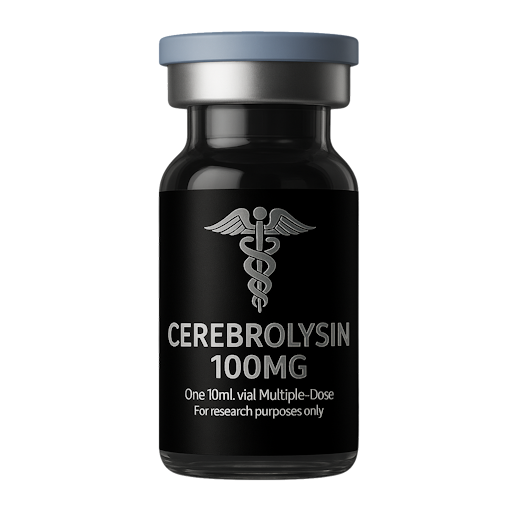
Cerebrolysin is a standardized peptide and amino-acid fraction derived from neuroprotein hydrolysate, investigated for neurotrophic and neuroprotective properties in preclinical and translational research. Experimental use centers on synaptic plasticity, neuronal survival pathways, and circuit-level functional recovery models under ischemic, traumatic, or degenerative stress conditions.
Trophic Signaling: Literature explores BDNF/NGF-like activity with downstream Trk receptor–linked
cascades engaging PI3K/Akt, MAPK/ERK, and CREB-dependent transcription to support neuronal survival
and synaptogenesis.
Mito/Proteostasis: Reports assess attenuation of mitochondrial dysfunction, reduction of oxidative
injury, and support of proteostasis/autophagy programs under cellular stress.
Inflammation & Excitotoxicity: Models examine modulation of microglial reactivity, cytokine tone,
and glutamatergic excitotoxic pathways relevant to network stability and plasticity.
Functional Notes: Emphasis on dendritic spine density, synaptic protein expression, and electrophysiologic
readouts that index circuit resilience and learning/memory paradigms.
Neuronal survival and plasticity assays • Ischemia/reperfusion and TBI models • Neuroinflammation and microglial phenotyping • Mitochondrial function and oxidative-stress studies • Synaptic proteome/transcriptome profiling • Behavioral and electrophysiologic endpoints in translational neuroscience.
Revitalized Health research products are prepared under cGMP-aligned conditions using pharmaceutical-grade inputs. Each lot of Cerebrolysin is verified for composition consistency and identity by chromatographic profiling (e.g., HPLC) with confirmatory mass analysis (LC-MS/MS). Appearance, pH/osmolality (where applicable), and microbial/endotoxin limits are assessed to research-grade specifications. Batch-level Certificates of Analysis document analytical methods and results.
Store sealed containers at 2–8 °C, protected from light and moisture. For aliquoted liquid research formats, avoid multiple freeze–thaw cycles; for lyophilized formats, reconstitute with bacteriostatic water, maintain at 2–8 °C, and utilize within 20 days. Record lot/expiry and maintain chain-of-custody for study traceability.
For laboratory research use only. Not intended for human consumption, therapeutic, or diagnostic application. Supplied exclusively to qualified professionals conducting controlled scientific investigations.
Formulated for research applications. Composition, identity, and lot analytics available per batch. Not medical advice.
Identity: Enzymatically derived low–molecular-weight neuropeptide and amino-acid fraction from porcine brain tissue.
Mode: Engages neurotrophic signaling (BDNF/TrkB-, NGF-related axes) and pro-survival cascades; supports synaptogenesis, dendritic spine stability, and metabolic resilience under excitotoxic/ischemic stress in models. Reported functional domains include anti-apoptotic signaling, microglial modulation, and improved neuroplasticity during rehab paradigms.
Analytics: Fingerprint profiling by HPLC/LC-MS of peptide fraction; amino-acid composition; sterility (USP <71>), endotoxin (USP <85>), osmolality and pH. PD readouts: stroke/TBI scales (NIHSS, mRS, Barthel), global cognition (MMSE/MoCA), psychometrics, EEG/fMRI connectivity, and serum biomarkers (BDNF, NSE). Monitoring: infusion-site reactions, BP/HR, dizziness/headache; hypersensitivity history.
Educational, research-style product content. Not medical advice or a treatment claim.