
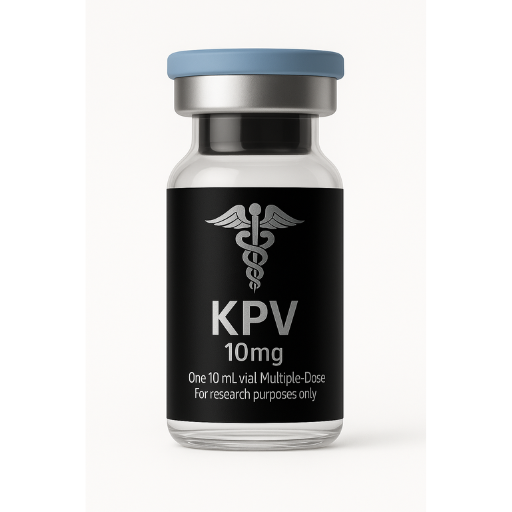
KPV (Lys-Pro-Val) 10mg is a tripeptide fragment derived from the melanocortin hormone α-MSH and is widely investigated for its potential involvement in anti-inflammatory signaling pathways. Research models explore its influence on cytokine activity, epithelial barrier function, and immune-modulation mechanisms across GI, dermal, and systemic frameworks.
Per vial composition: KPV 10 mg (lyophilized powder for reconstitution in research settings).
Melanocortin Pathway Interaction: KPV is studied for its capacity to modulate inflammation-linked
signals associated with melanocortin receptors and downstream immune pathways.
Cytokine & Chemokine Effects: Experimental endpoints commonly evaluate changes in TNF-α, IL-6,
IL-1β, and other inflammatory mediators in response to KPV exposure.
Barrier & Cellular Protection: Research explores effects on epithelial and mucosal integrity,
oxidative-stress markers, and immune-cell behavior in both localized and systemic models.
Inflammatory-cascade studies • GI barrier and epithelial models • Dermatologic and wound-healing frameworks • Cytokine/chemokine signaling assays • Immune-modulation investigations • Oxidative-stress and tissue-protection experiments • PK/PD profiling of α-MSH–derived peptide fragments.
Revitalized Health research peptides are produced under cGMP-aligned manufacturing with pharmaceutical-grade inputs. Each KPV 10mg lot is verified at ≥99% purity via HPLC, and identity is confirmed using LC-MS/MS. All batches undergo solubility checks, visual inspection, and microbial/endotoxin screening. Batch-specific Certificates of Analysis provide full analytical traceability.
Store lyophilized KPV 10mg at 2–8 °C, protected from light and moisture. After reconstitution with bacteriostatic water, maintain at 2–8 °C and use within 20 days. Avoid repeated freeze–thaw cycles to preserve peptide integrity and biological consistency in experimental use.
For laboratory research use only. Not intended for human consumption, therapeutic application, or diagnostic use. Provided exclusively to qualified professionals conducting controlled scientific experimentation.
Formulated as KPV 10mg for research use only. Purity, identity, and analytical results available per batch. Not medical advice.
Identity: KPV (Lys–Pro–Val), a tripeptide fragment of α-melanocyte–stimulating hormone (α-MSH),
supplied as a 10mg lyophilized research peptide for inflammatory and barrier-function models.
Mode:
• Engages melanocortin signaling (notably MC1R) on epithelial and immune cells.
• Evaluated for suppression of NF-κB activation and reduction of pro-inflammatory cytokines
(e.g., TNF-α, IL-1β, IL-6) in vitro and in vivo models.
• Research focuses on support of gut and skin barrier integrity, modulation of innate immune tone,
and reduction of inflammatory damage under chemical and mechanical stressors.
Analytics: HPLC purity; LC-MS/MS identity; sequence confirmation; endotoxin via LAL; solubility and appearance checks under research conditions.
PD readouts: cytokine/chemokine panels, NF-κB reporter assays, transepithelial electrical resistance (TEER),
histologic scoring of mucosal/skin inflammation, oxidative-stress biomarkers.
Monitoring (research): local tolerability, global inflammatory markers, barrier-function metrics, and dose–response behavior.
For educational/research-style product content. Not medical advice; not for human use.