
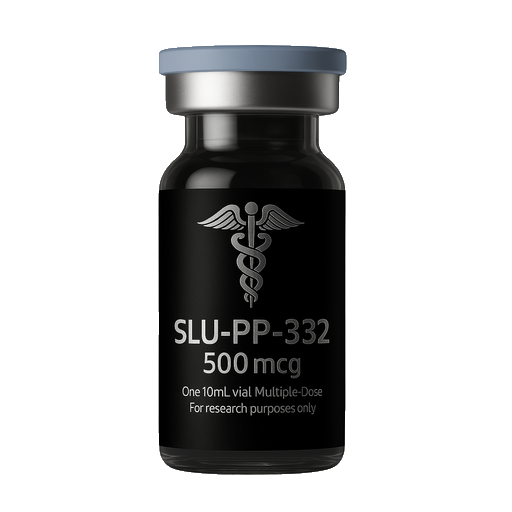
SLU-PP-332 is an experimental research compound utilized to investigate cellular energy regulation, metabolic signaling, and stress-adaptation programs in preclinical systems. Current research explores its effects on pathways governing substrate utilization, mitochondrial efficiency, and exercise-like transcriptional responses in skeletal muscle and hepatic models. Pharmacological profiling remains an active area of investigation, and data are interpreted strictly within controlled laboratory settings.
Putative Biology: Studies evaluate SLU-PP-332 for modulation of energy-sensing networks and
mitochondrial programs associated with adaptive metabolism.
Pathway Readouts (models): Investigations commonly monitor markers linked to AMPK activation,
PGC-1α–associated transcription, fatty-acid oxidative flux, and mitochondrial respiratory capacity
(e.g., OCR/ECAR profiling), while receptor selectivity and direct molecular targets continue to be characterized.
Functional Notes: Experimental designs focus on dose–response behavior, time-course kinetics,
and reversibility, with attention to off-target signals and cytotoxicity thresholds.
Skeletal-muscle metabolic adaptation • Hepatic lipid handling and β-oxidation assays • Mitochondrial bioenergetics (Seahorse/Clark electrode) • Exercise-mimetic transcriptional programs • Nutrient stress and redox-homeostasis models • Comparative studies versus canonical AMPK/PGC-1α modulators.
Revitalized Health research compounds are produced under cGMP-aligned conditions with pharmaceutical-grade inputs. Each SLU-PP-332 lot is confirmed at ≥99% purity by HPLC with structure/identity assessed via LC-MS/MS. Lots undergo appearance and solubility checks and microbial/endotoxin screening to research-grade specifications. Batch-specific Certificates of Analysis document analytical methods, parameters, and results.
Store lyophilized material at 2–8 °C in a dry, light-protected environment. Following reconstitution with bacteriostatic water, maintain at 2–8 °C and utilize within 20 days. Avoid repeated freeze–thaw cycles to preserve compound integrity and experimental reproducibility. Record lot/expiry and maintain chain-of-custody documentation for study traceability.
For laboratory research use only. Not intended for human consumption, therapeutic, or diagnostic application. Supplied exclusively to qualified professionals conducting controlled scientific investigations.
Formulated for research applications. Purity, identity, and lot analytics available per batch. Not medical advice.
Identity: Small-molecule pan-estrogen-related receptor (ERRα/β/γ) agonist with exercise-mimetic transcriptional activity.
Mode: Stabilizes active ERR conformation → co-activation with PGC-1α → upregulates OXPHOS, β-oxidation, and mitochondrial biogenesis programs; increases oxidative muscle fiber signature and endurance in murine studies; improves metabolic indices in obese/aged mouse models.
Analytics: Identity/purity by HPLC/LC-MS; receptor binding/EC₅₀ via reporter assays; transcriptomics (ERR target gene panels), high-resolution respirometry (OCR, spare capacity), acyl-carnitine profiling, and in vivo indirect calorimetry. Monitoring (research): body temperature/thermogenesis, activity/EE by CLAMS, lipid/glucose panels; observe for stimulatory or GI effects depending on vehicle.
Educational, research-style site content about an investigational exercise-mimetic. Not medical advice or a treatment claim.